By wattforcamp.com Editorial · Corrections: editor@wattforcamp.com
The Anker SOLIX C1000 Gen 2 is the ~1 kWh class station many 2026 car-camping roundups mention for fast wall recharge and high solar input caps. This guide is an in-depth camping-focused evaluation: how the pack behaves in a SUV trunk loop, what power draw looks like for common appliances, how app control helps (and what it cannot fix), and where car integration fits between picnic-table outlets and van electrical projects.
Methodology: We cross-check Anker published specs (model A17630 family), owner-report themes on major retailers, and planning math used across Watt for Camp guides. We have not run a multi-week instrumented field lab on a single press unit; runtime figures are worksheets you should tune to your fridge and weather. Where we describe setup photos, figures are editorial diagrams from our camping layout notes—swap in your own trunk measurements before buying.
Disclosure: Watt for Camp participates in the Amazon Associates Program. As an Amazon Associate, we may earn from qualifying purchases. Outbound product links use rel="sponsored" and the tracking tag wattforcamp20-20. See our disclosure page.
Shop the SKU (verify Gen 2 listing): Anker SOLIX C1000 Gen 2 on Amazon
Pair this review with our hero roundup Best portable power stations for car camping 2026, sizing path What size portable power station do I need?, and sister-site Car Camp Kit — car camping power solutions for fridge + trunk zoning. For recovery gear powered off the same brick after hiking days, see Gym Science (fans, massage guns, modest home gym loads). EcoKit covers broader off-grid context when car camping grows into seasonal basecamp planning.
Verdict for car campers (30 seconds)
Buy the C1000 Gen 2 when you want a ~1 kWh LiFePO4 station with strong AC output (2000 W continuous, 3000 W peak published), 600 W solar input (60 V max), and ~49-minute class wall recharge marketing that actually matters for Friday-night top-offs before a two-night state-park loop. It fits two-adult fridge + phones if you recharge once from wall or 12 V driving.
Pause when you need two full nights with zero recharge on a hot-weekend fridge—step to ~2 kWh (Bluetti AC200L class or Jackery Explorer 2000 v2 class). Pause also if cargo weight is the bottleneck; ~25 lb is real on gravel parking lots.
At-a-glance: capacity, price, noise
Confirm Gen 2 on the carton—older C1000 (Gen 1) listings still circulate with different port counts and inverter bands.
| Attribute | Anker SOLIX C1000 Gen 2 (published) | Car-camping read |
|---|---|---|
| Capacity | 1,024 Wh (LiFePO₄) | ~920–970 Wh usable after protection slice—plan 85–90% for cycling loads |
| AC output | 2,000 W continuous, 3,000 W peak | Handles fridge on AC plus laptop burst; still avoid kettle + fridge start stacking |
| Street price band | ~$650–$800 (bundle-dependent) | Competitive $/Wh vs EcoFlow DELTA 2 class |
| Weight | ~24.9 lb (11.3 kg order of magnitude) | One-person carry possible; two-person safer on wet gravel |
| Noise (inverter fan) | Fan ramps under high AC load | Keep heavy AC off quiet hours; prefer 12 V DC fridge when cable allows |
| Solar input | 600 W max, 60 V VOC max | Extension, not tree-shade autonomy—see solar section |
| Wall recharge | Up to ~1,600 W “UltraFast” mode (verify app toggle) | Excellent for same-day turnaround between trips |
Comparison: capacity and price vs nearby classes
| Model class | Wh (typical) | Street band (USD) | Fan / noise theme (owner reports) |
|---|---|---|---|
| Anker SOLIX C1000 Gen 2 | 1,024 | ~$650–800 | Moderate fan under AC load; quieter at USB-only night |
| EcoFlow DELTA 2 | ~1,024 | ~$650–850 | App-forward; fan complaints cluster at bedtime AC |
| Jackery Explorer 1000 v2 | ~1,070 | ~$700–900 | Simpler UI; slower car input vs some rivals |
| EcoFlow RIVER 2 Pro | ~768 | ~$550–700 | Lighter; not a 24/7 fridge primary |
Full eight-model table: Best portable power stations for car camping 2026.
What is in the box (camping-relevant)
Typical station-only SKUs include the C1000 Gen 2 brick, AC charging cable, car charging cable, and documentation. Solar bundles add Anker-branded panels (for example PS200 / PS400 classes)—verify connector, VOC, and parallel rules in the manual before mixing third-party glass.
Ports that matter at the picnic table:
- AC outlets — Gen 2 ships five 120 V grounded outlets on many listings (confirm your cart photo).
- USB-C — Two high-watt USB-C tiers (up to 140 W class on published materials) for laptop + phone without inverter overhead.
- USB-A — Lanterns and older camera batteries.
- 12 V car port — DC-native fridge cord when your cooler supports it—often better Wh efficiency than AC adapter bricks.
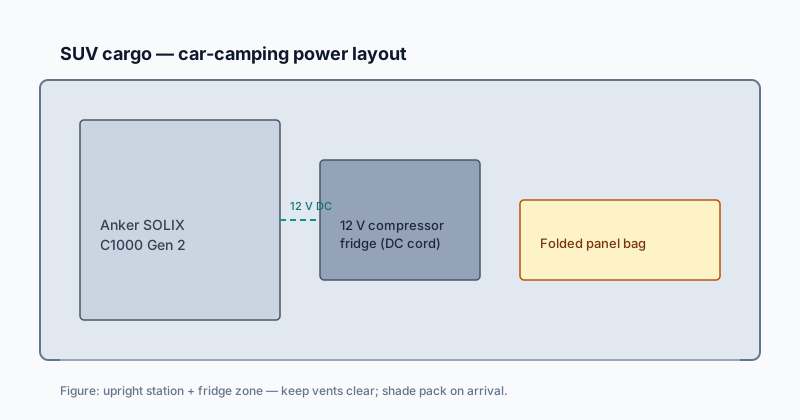
Figure 1 — Trunk zoning: upright station, fridge on DC when possible, panel bag where it will actually deploy.
Camping load test: power draw scenarios
We score camping usability with the same Wh/day worksheets as our hero roundup. Adjust watts to your fridge and climate.
Assumptions (single-night baseline)
| Load | Planning watts (average) | Hours / day | Wh / day |
|---|---|---|---|
| Compressor fridge (mild) | 35 W | 24 | 840 |
| Compressor fridge (hot afternoon) | 50 W | 24 | 1,200 |
| Phone + watch USB | 12 W | 2 | 24 |
| LED lantern | 4 W | 5 | 20 |
| Laptop charge cycle | 65 W | 1.5 | 98 |
| 12 V USB fan | 8 W | 8 | 64 |
Estimated nights on one full charge (C1000 Gen 2, ~970 Wh usable)
| Daily stack | Wh / day | Nights without recharge |
|---|---|---|
| Fridge (mild) + phones | 864 | ~1.1 |
| Fridge (mild) + laptop + lantern | 958 | ~1.0 |
| Fridge (hot) + phones | 1,224 | < 1 — plan daily top-up |
| Phones + lantern only | 44 | Many nights (not why you bought 1 kWh) |
Camping takeaway: The C1000 Gen 2 is a default two-adult weekender when fridge + devices includes one recharge from wall Friday or 3–6 hours driving between parks. It is not a three-night hot-weekend fridge brick without solar or car input.
Single-appliance hours (simplified, ~970 Wh usable)
| Device | Planning W | Approx. hours |
|---|---|---|
| 12 V fridge (average) | 45 W | ~21 h |
| CPAP | 40 W | ~24 h |
| Laptop while charging | 65 W | ~15 h |
| LED lantern | 4 W | ~240 h |
For CPAP-forward trips, published 2000 W AC is ample; still log hours and humidifier add-ons honestly.

Figure 2 — Use app watt meters to compare solar fantasy vs partial shade reality.
App control: what helps at camp
The Anker app (Bluetooth/Wi-Fi depending on firmware) is genuinely useful for car campers who want visibility, not RV panel automation.
High-value screens:
- Input watts — Watch 12 V car charge while driving; confirms whether your vehicle outlet is the bottleneck.
- Output watts — Catch a space heater someone plugged into AC during quiet hours.
- UltraFast / charging modes — Enables ~1,600 W wall path when circuit and cable allow—great between trips, not at most campground pedestals (often 15 A limits).
- Battery protection floor — Explains sudden shutdown near ~10–20% on LFP—plan usable Wh, not nameplate.
What the app does not do: It cannot angle your panel, cool your trunk, or lower compressor duty cycle on a 90 °F afternoon. Treat notifications as telemetry, not autonomy.
Real-world car integration
12 V car charging is the car-camping superpower when you move sites every day. Published car input bands for this class are often ~100–130 W—enough to recover a fraction of a fridge night, not a full pack on a two-hour grocery run.
Safe practices (manual-aligned, not wiring advice):
- Prefer engine-running guidance from Anker when drawing high car input—protect the starter battery.
- Engine-off outlet charging can work for small top-ups; know whether your SUV outlet stays live when keyed off.
- Route cables so tailgate pinch and hot exhaust zones are avoided.
- Pair with Car Camp Kit gear layout so the station breathes—do not bury vents under sleeping bags.
Driving between parks math: 3 hours at ~120 W ≈ 360 Wh—roughly one-third of usable capacity—often the difference between sleeping with 8% and ending at 35% on night two.
For fridge-specific draw bands before you buy, see best portable car fridge.
Solar at the campsite
Anker markets ~1.8 h full recharge with 600 W solar—ideal noon, clear sky, correct VOC. Car-camping reality under pine canopy is 80–200 W effective for short sun windows.
Checklist before you trust a bundle:
| Check | Why it matters |
|---|---|
| Panel VOC under 60 V | Gen 2 publishes 60 V max on solar input |
| Approved adapter | Wrong XT60 / 8 mm adapter is the top owner error |
| Panel angle + kickstand | Dead-flat roof placement on drive-up sites underperforms |
| Parallel only when manual allows | Mismatch voids warranty stories in Q&A threads |
Optional panels: Anker SOLIX PS200 class search · Anker SOLIX PS400 class search
Pros and cons (camping-specific)
Pros
- Strong AC headroom (2000 W) for fridge + laptop without the 800 W anxiety of budget tiers.
- Fast wall turnaround when UltraFast mode is enabled—excellent Friday-after-work prep.
- 600 W solar input cap—among the higher numbers in the ~1 kWh band for sunny shoulder afternoons.
- USB-C PD tiers reduce inverter fan time vs charging everything on AC bricks.
- LiFePO₄ chemistry and long-cycle marketing (4000+ cycles to 80%) fit seasonal campers who charge weekly in summer.
- App telemetry helps debug shade and car-charge issues without a multimeter.
Cons
- ~1 kWh still pins you to one hot fridge night without recharge—not a long-weekend autopilot pack.
- Weight ~25 lb is heavier than RIVER 2 Pro class—feel it on wet campground loops.
- Inverter fan can be noticeable tent-adjacent under AC-heavy loads—route DC fridge when possible.
- Bundle confusion — Gen 1 vs Gen 2 and C1000X port layouts require cart vigilance.
- Car input watts are not the fastest in the market—EcoFlow SKUs sometimes win driving recovery.
- Price rises fast with panels—buy station first, panel second if you already own compatible glass.
Gen 2 vs Gen 1 (buyer sanity)
Both generations advertise 1024 Wh and 600 W solar. Gen 2 emphasizes 2000 W AC (3000 W peak), 60 V solar VOC, and faster HyperFlash wall paths. If a deal looks too cheap, confirm A17630 Gen 2 imagery and outlet count—not a refurbished Gen 1 with 1800 W class inverters.
Head-to-head hints (not a full NIC-350 review)
| Question | Lean C1000 Gen 2 | Lean rival |
|---|---|---|
| Fastest Friday wall charge | Anker UltraFast narrative | DELTA 2 if your circuit already likes EcoFlow app habits |
| Simplest UI on the table | Jackery 1000 v2 | If you dislike app dependency |
| Highest continuous AC in 1 kWh | Tie band—verify simultaneous loads | DELTA 2 ~1800 W published |
| Lightest lift | Not Anker—look RIVER 2 Pro | EcoFlow RIVER 2 Pro |
Full three-way: Jackery Explorer 2000 v2 vs EcoFlow DELTA 2 Max vs Bluetti AC200L (NIC-350).
Cross-empire: gymscience and carcampkit
- Car Camp Kit — power solutions 2026 — SUV runtime tables and fridge pairing with the same 864 Wh/day math.
- Car Camp Kit — portable car fridge roundup — Average W before you trust 1 kWh.
- Gym Science — Modest home gym and recovery loads; many readers run percussion massagers (~60–80 W bursts) and USB fans from the same station after trail days. Size AC headroom if you add countertop blender fantasies to camp breakfast—usually propane wins.
Setup checklist (first trip)
- Full wall charge at home with UltraFast only on a known-good 15–20 A circuit.
- Label your DC fridge cord—test 12 V port before you leave cell service.
- Photograph serial label for warranty—trunk dust is normal abuse, not indoor backup climate.
- Set app alerts for low battery at 20% if CPAP is in play.
- Pack panel only if you will deploy it—otherwise it is dead weight next to camping stove gear.
FAQ
Is the Anker SOLIX C1000 Gen 2 good for car camping with a fridge?
Yes for typical two-night loops with one recharge (wall or driving). No as a solo brick for three hot nights with no input—size to ~2 kWh or add real solar hours.
How loud is the C1000 Gen 2 at a tent-adjacent site?
Fan noise scales with AC load. USB-C nights are quieter than AC adapter stacks. Keep high-watt kitchen toys in daytime cooking blocks.
C1000 Gen 2 vs Jackery Explorer 1000 v2 for SUVs?
Similar Wh band. Choose Anker for faster wall + solar input story and app; choose Jackery for ecosystem simplicity and accessory familiarity. Compare tables in our 2026 hero guide.
Can I run a CPAP on this station?
Published AC and Wh fit common CPAP averages for multiple nights if humidifier watts are included—always keep a battery backup per medical guidance.
What tracking tag do Watt for Camp links use?
wattforcamp20-20 on Amazon search and product paths. Clicks fire affiliate_outbound_click in GA4 when consent is granted—verify in tag assistant after deploy. Empire-wide tags may differ on sister sites; this article uses wattforcamp only.
Bottom line
The Anker SOLIX C1000 Gen 2 earns its 2026 shortlist spot for car campers who want ~1 kWh LiFePO4, 2000 W AC, and credible fast charging between weekend loops. It is the right size when fridge + devices includes honest recharge—and the wrong size when you treat 600 W solar marketing as guaranteed tree-shade autonomy. Re-read the hot-fridge row in the nights table before checkout; that single line prevents most one-star trunk stories.
Primary shop path: Anker SOLIX C1000 Gen 2 — verify Gen 2 SKU
Related on Watt for Camp